
Guide to Choosing Your Welding Machine
Last Updated: August 9, 2025 by Louis Sham
Deciding between renting and buying welding equipment is crucial based on your welding needs and financial considerations. Purchasing a welding machine might offer long-term value, especially if you regularly engage in commercial projects, as it allows for ownership, customization, and consistent availability. However, renting can be advantageous if your projects are sporadic or require specialized tools. Renting not only frees up capital but also provides the flexibility to test newer machines or switch between different types of welders as needed.
Factors Influencing the Choice of Welding Process
Choosing the right welding process involves considering various factors such as the technique, skill level, and features of the welding equipment. For instance, MIG welding is often favored for its ease of use and speed, making it ideal for beginners and large projects. TIG welding, on the other hand, requires more skill but offers superior precision and control, perfect for detailed work on thin materials or specialty alloys. Understanding these nuances helps in selecting the most suitable process for your welding projects.
Factors to Consider When Choosing a Welding Machine
Choosing the right welding machine involves more than just aligning it with a specific welding method. Factors such as the type of welding, material to weld, and power supplies play a significant role. A thorough assessment of the project requirements, the materials involved, and the desired welding outcomes is essential in selecting a machine that meets your needs. Additionally, considering the environment in which you will be working, whether it’s a workshop or an industrial site, is crucial for making an informed decision.
Welding Process
The welding process you choose directly influences the type of welding machine you need. For instance, Stick welding is suitable for outdoor welding and less-than-ideal conditions due to its simplicity and versatility. In contrast, TIG welding offers precision and control for projects involving thin or specialized materials. Understanding the strengths and limitations of each welding process is key to ensuring you select the right equipment for your specific applications.
Material to Weld
The material you intend to weld is a critical factor in choosing the right welding machine. Different metals and their thicknesses demand specific amperage ranges, arc characteristics, and filler materials. For example, welding aluminum often requires a machine capable of higher amperage for effective penetration, while thinner metals benefit from lower amperage and precise control. Selecting the appropriate machine ensures optimal performance and quality in your welding projects.
Power Supplies
Welding machines vary in their input power requirements, ranging from standard 120V options for light-duty tasks to robust 460V setups for heavy-duty industrial applications. It is essential to evaluate the electrical infrastructure at your facility or job site to ensure compatibility and prevent circuit overloads. Understanding the power supply needs of your welding equipment allows for seamless integration and uninterrupted operation, enhancing the efficiency of your welding projects.
Duty Cycle
The duty cycle of a welding machine indicates how long it can operate at a given amperage before requiring a cooldown to prevent overheating. This factor is crucial for continuous welding tasks and varies depending on the machine’s capacity and the ambient temperature of the environment. Machines with a higher duty cycle are often preferred in industrial settings where prolonged use is necessary. Adjusting to the duty cycle ensures the longevity and reliability of your welding equipment.
Amperage Range
The amperage range of a welding machine determines its capability to handle different metal thicknesses and types. Higher amperages are essential for welding thicker materials, providing deep penetration and strong welds. Conversely, lower amperage settings are suitable for thin metals, allowing for precise control and minimal distortion. Understanding the amperage requirements of your projects ensures you select the right machine, optimizing both performance and quality in your welding tasks.
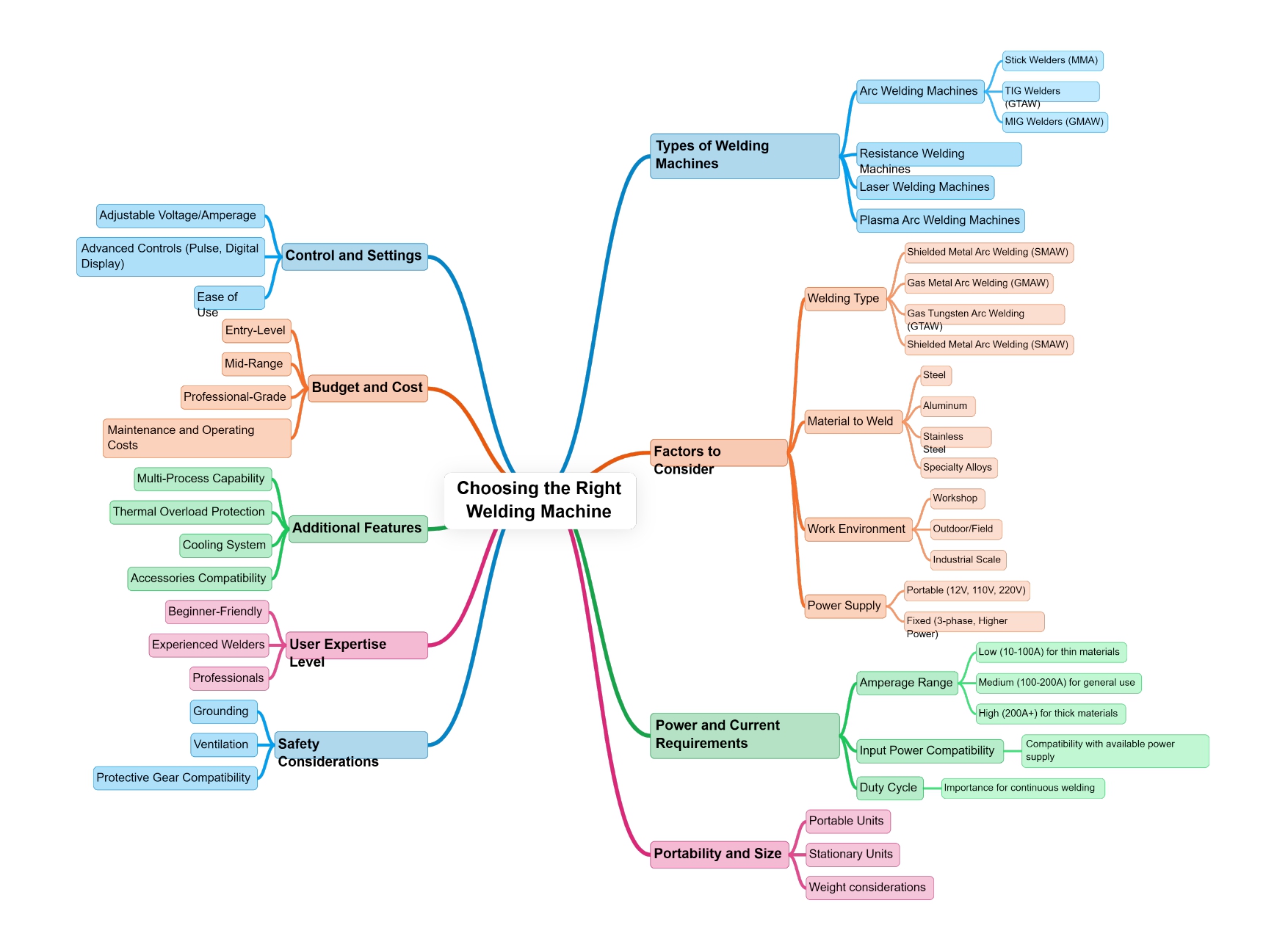
Click the above mind map image to open it in its full size
Choosing the Right Welding Method
Understanding Welding Types
To choose the right welding method, it is essential to understand the various types of welding processes available. Each welding type offers unique advantages and is suited for specific applications. For instance, MIG welding is favored for its speed and ease of use, making it ideal for beginners and large-scale welding projects. On the other hand, TIG welding provides superior precision, perfect for intricate welds on thin materials or specialty alloys. Stick welding is a versatile option suitable for outdoor welding and less-than-ideal conditions. Understanding these welding types allows you to select the right method for your welding needs.
Choosing the Right Welding Equipment
Choosing the right welding equipment is essential to achieving strong, precise, and reliable welds, whether manufacturing large-scale components or performing minor repairs. The selection process involves evaluating the specific requirements of your welding projects, such as the type of weld needed, the materials involved, and the desired welding outcomes. Considerations like power supplies, amperage range, and duty cycle are crucial in determining the most suitable welding machine. By aligning your welding equipment with your project needs, you ensure optimal performance and quality in your welding endeavors.
Buying Your First Welder
Buying your first welder is an exciting step for anyone entering the world of welding. As a beginner, it is important to choose a welder that matches your skill level and project requirements. Entry-level machines like basic MIG welders or stick welders offer ease of use and versatility, making them perfect for newcomers. Consider factors such as portability, power needs, and welding capabilities when selecting your first welding machine. By making an informed choice, you set the foundation for successful and enjoyable welding experiences.
Work Environment Considerations
Workshop vs. Outdoor/Field
The work environment significantly influences the choice of welding equipment and method. In a workshop setting, controlled conditions allow for the use of more sophisticated welding machines like TIG welders, which require stable environments for precision work. Conversely, outdoor or field welding often necessitates robust equipment like stick welders, which can handle challenging conditions and do not require external shielding gas. Understanding the demands of your work environment is crucial in selecting the right welding equipment and process.
Industrial Scale Welding
Industrial scale welding involves large, continuous welding operations that demand powerful and reliable welding machines. Machines with a higher duty cycle are crucial in these settings to ensure sustained performance without overheating. Multi-process welders and advanced MIG or TIG welders are often employed in industrial applications due to their versatility and efficiency. Additionally, the ability to handle high amperage is necessary for welding thicker materials commonly used in industrial projects. Selecting the appropriate equipment ensures productivity and quality in industrial welding environments.
Portability and Size
Portability and size are important considerations when selecting a welding machine, especially for businesses operating across multiple locations or in confined spaces. Portable welders, often powered by 12V, 110V, or 220V, are ideal for on-the-go welding needs, although they may sacrifice some power and features compared to fixed, 3-phase machines. Lightweight and compact designs facilitate easy transportation and setup, making portable welders a suitable choice for fieldwork and small workshops. Balancing portability with the required welding capabilities ensures efficiency and convenience in diverse work environments.
Additional Features of Welding Machines
Adjustable Voltage/Amperage
Adjustable voltage and amperage settings in welding machines greatly enhance their versatility and adaptability to different welding projects. By allowing welders to fine-tune the power output, these features enable precise control over the welding arc, which is crucial for achieving high-quality welds across various metal thicknesses and types. This capability is particularly beneficial in MIG and TIG welding applications, where precise adjustments can significantly impact the weld’s strength and appearance. Choosing the right machine with adjustable settings ensures optimal performance tailored to specific welding needs.
Advanced Controls
Advanced controls in modern welding machines, such as pulse settings and digital displays, provide welders with enhanced oversight and precision during the welding process. These features allow for greater control over the welding arc, improving the consistency and quality of welds. Pulse settings, for example, are especially useful in TIG welding, where they help manage heat input and minimize distortion on thin materials. Digital displays offer intuitive feedback on machine settings, aiding in accurate adjustments and contributing to more efficient and precise welding outcomes.
Thermal Overload Protection
Thermal overload protection is a critical safety feature in welding machines, safeguarding both the equipment and the welder from potential hazards. This feature automatically cuts the power to the torch or gun if the internal circuit begins to overheat, preventing damage to the machine and reducing the risk of accidents. Built-in thermal overload protection is particularly important for continuous welding tasks where the machine is subjected to prolonged use. By opting for equipment with this safety mechanism, welders can ensure both operational safety and the longevity of their welding investments.
Safety Considerations
Grounding Requirements
Grounding requirements are fundamental safety considerations when selecting welding equipment. Proper grounding ensures that any stray electrical currents are safely directed away from the welder, reducing the risk of electric shock. This is especially important in environments where moisture or conductive surfaces are present. Choosing a welding machine with built-in grounding features enhances safety and compliance with industry standards, providing peace of mind and protecting both operators and equipment from electrical hazards.
Ventilation Needs
Ventilation is a crucial factor in maintaining a safe and healthy welding environment. Welding processes, especially arc welding, generate fumes and gases that can be hazardous if inhaled. Adequate ventilation systems or personal protective equipment like respirators are necessary to mitigate these risks. When selecting a welding machine, consider the work environment and ensure that proper ventilation is available to safeguard the health and well-being of welders. This consideration is vital in enclosed spaces where fumes may accumulate more readily.
Protective Gear Compatibility
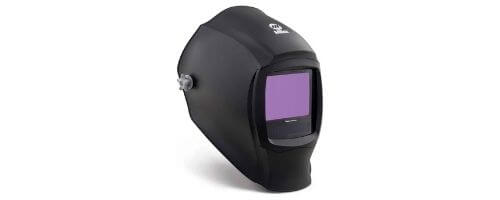
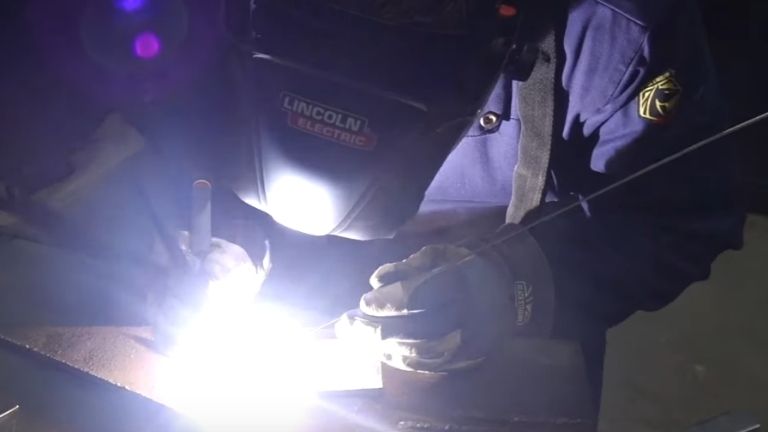
Compatibility with protective gear is essential when choosing the right welding machine. Arc welding generates intense light, heat, and UV radiation, necessitating the use of helmets, gloves, and protective clothing to prevent burns and UV exposure. Helmets protect the face, neck, and head, while gloves and specialized clothing shield the body. Ensuring that the chosen welding equipment accommodates and integrates well with these safety accessories is critical for maintaining a safe working environment and protecting welders from potential hazards.